Independent venture · In development
YazarIS
Every order starts with a conversation.
An AI-assisted order assistant turning Turkish B2B messages into catalog-validated drafts, with human confirmation at the center.
Follow the order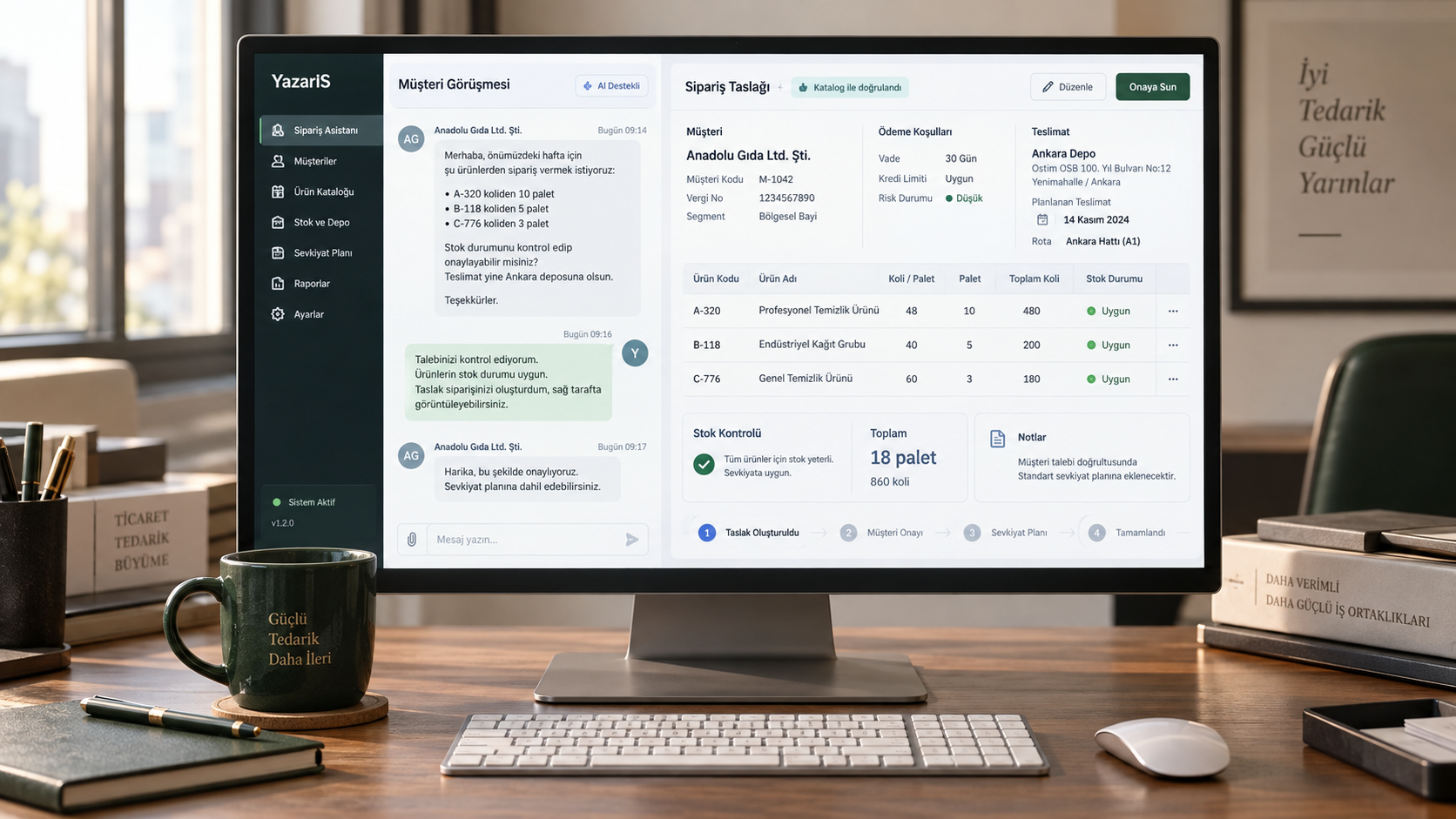
TÜBİTAK BiGG / BİGGNITE
First stage passed.
A founder-reported accelerator milestone, recorded in the project documentation. It is not an investment or funding decision.
The problem
Natural language.
Operational consequences.
Wholesale orders arrive as shorthand, corrections and references to earlier messages. A plausible interpretation is not enough: the product, quantity and unit must match the business catalog.
The initial product direction is packaging and cleaning wholesalers in Kahramanmaraş: an operator pastes a message, reviews the draft and remains in control.
The engineering story
Understand.
Validate.
Confirm.
An understandable decision at every step.
- 01
Intent before inference
Distinguish a new order from a correction, cancellation or price question. Earlier context must never turn a cancellation into a fresh order.
create_order · modify_order
cancel_order · ask_price - 02
The catalog is the boundary
Resolve products against the catalog and validate allowed units and quantities. Unclear requests become review or clarification states rather than silent guesses.
draft → needs_review
→ needs_clarification - 03
One confirmation. An audit trail.
The implemented SQLite store encrypts draft payloads and protects creation and confirmation against concurrent retries. Confirmation and its audit event share a transaction.
SQLite · AES-GCM
idempotency · audit
My role
Product intent.
Engineering discipline.
Founder & developer
My work connects the product scope with the underlying order contracts, catalog resolution, evaluation datasets and persistent draft lifecycle.
A key decision is to measure whether a draft is safe to accept, not merely whether a model returns valid JSON. The project records rejected model candidates and keeps synthetic, human and operational evidence separate.
Evidence, with context
Designed to be checked.
Fictional catalog SKUs
Programmatically generated examples
Human-origin messages in an internal evaluation set
These describe development datasets, not customers, live orders or production accuracy. Historical resolver scores do not establish the quality of the current version.
Where the project stands
Built today
- Typed order contracts, intent handling and catalog validation.
- Encrypted draft storage, idempotent creation and transactional confirmation.
- FastAPI boundaries and reproducible evaluation infrastructure.
Next product milestones
- Complete decimal quantity handling in free text and model output.
- Build the business API, operator interface and reviewed CSV/XLSX export.
- Validate usefulness with real businesses before making adoption or production claims.
Private source. Clear scope.
This case study was checked against the private repository on 12 September 2026. The product is in development; a public demo and automatic ERP submission are not available.